
Handyman tips
How to Fill a Hole in Plasterboard, Small to Large
How to repair nail holes, dents and larger holes in a plasterboard wall or ceiling, with the tools and the steps for each size.
· Handyman Manchester
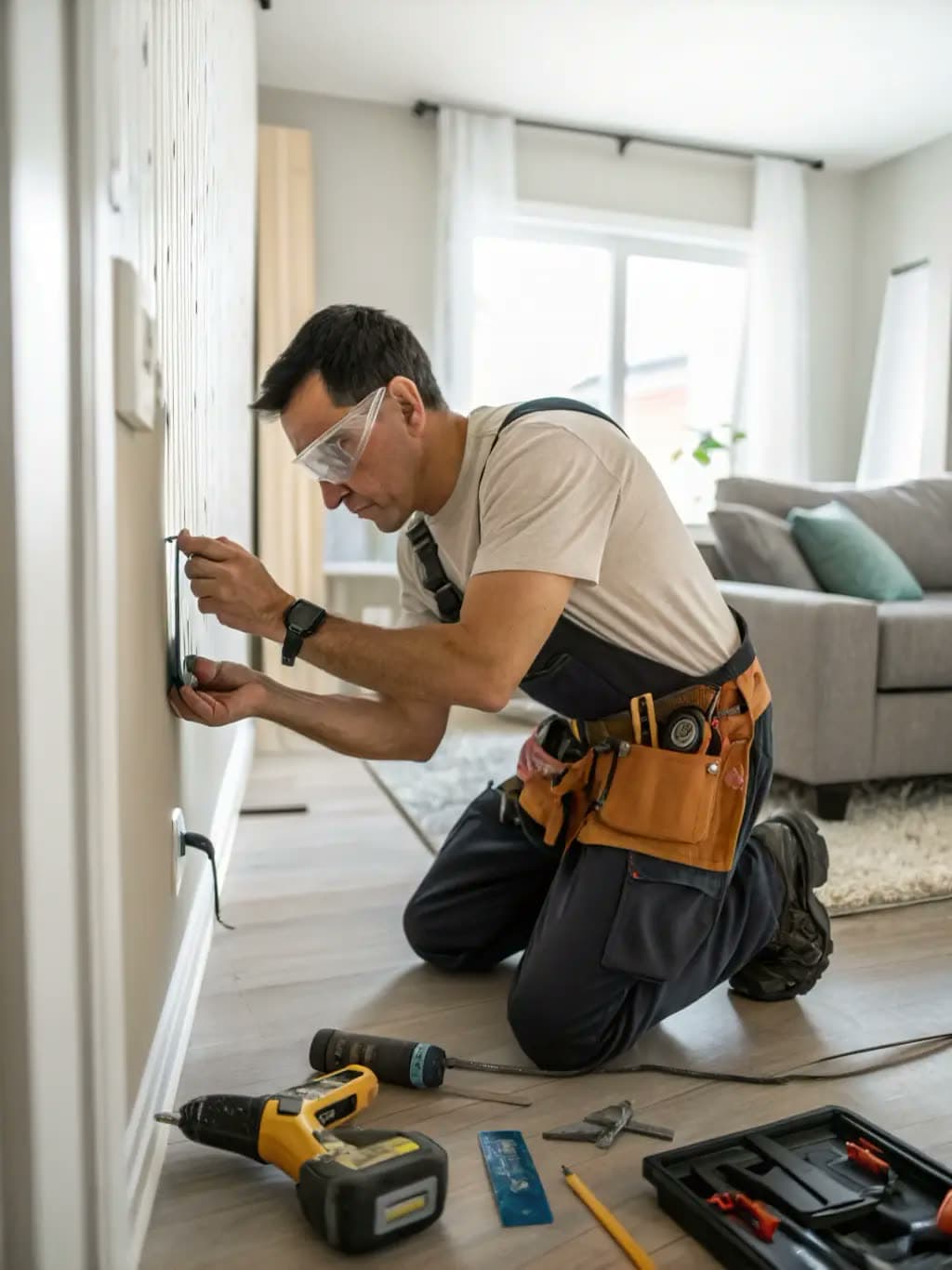
The right repair depends on the size of the hole. The steps below follow guides from Homebuilding & Renovating and Screwfix. Both split the job into small holes, holes that need a patch, and holes that need new plasterboard fixed behind the wall.
Nail and screw holes, and dents
Remove any debris and rough edges, and clean the dust out so the filler sticks. Press filler into the hole with a filler knife and leave it slightly proud of the wall. Screwfix suggests a filler such as Polyfilla. Once it is dry, sand it flat. Homebuilding suggests 180 to 220 grit sandpaper for screw holes.
Homebuilding says decorators' caulk also works for nail and screw holes, but not for holes bigger than about a quarter of an inch. Caulk cannot really be sanded, so smooth it with a putty knife or a wet finger.
Holes up to about 6 inches
Homebuilding describes this size as 1 to 6 inches, and Screwfix as up to about 6 by 6 inches. Screwfix uses a ready-made wall repair patch. Homebuilding cuts a plasterboard patch instead:
- Cut a rectangle around the hole with a steel rule and a Stanley knife, or mark it out and use a jab saw.
- Cut a piece of plasterboard slightly narrower than the hole and about an inch longer at the top and bottom.
- Screw a long screw into the middle of the patch to use as a handle, and put plasterboard adhesive on the patch at the top and bottom.
- Pull the patch into place behind the wall by the screw and leave it to dry.
- Remove the screw, fill over the patch with patching plaster, all purpose filler or multi-finish plaster, and spread it with a knife larger than the hole.
- Rub the repair down when it is dry, then paint.
Larger holes
Screwfix covers holes up to about 12 inches square with this method, and Homebuilding gives no upper size. Bigger holes need new plasterboard fixed to something solid. Homebuilding finds the studs either side of the hole, ideally with a digital stud detector, then cuts a rectangle around the hole and fits two noggins between the studs to fix the patch to. Screwfix instead screws two lengths of batten behind the old plasterboard, each about 8 inches longer than the hole so that it extends 4 inches behind the wall on either side. The two guides differ: Homebuilding fixes the new board to the studs, and Screwfix fixes it to the old board.
- Cut out the damaged plasterboard and clear the loose pieces and dust.
- Fit the noggins or battens, top and bottom.
- Cut a piece of plasterboard to fill the gap. Homebuilding says it should ideally be thinner than the existing board.
- Screw it to the noggins or battens with plasterboard screws.
- Cover the joints with fibreglass mesh tape, as Screwfix advises, to strengthen the edge of the patch.
- Fill with multi-finish plaster or filler. Homebuilding says to use two thin coats and let each dry as the manufacturer says.
- Sand with fine grit paper.
Before you cut or sand
Check for pipes and cables behind the board before you cut or fix anything. Screwfix lists a dust mask, safety glasses and gloves, and hearing protection if you use power tools. HSE says asbestos may be present in any building built or refurbished before 2000, including in textured coatings, so if the wall or ceiling has one, read our guide to Artex ceilings before you sand or cut it.
Ceilings
Homebuilding says the method is very similar on a ceiling. For a larger hole, find the joists either side of it and fit the noggins between them.
Painting the repair
Homebuilding says new plaster needs a mist coat to seal it before the next coats of emulsion. Screwfix suggests using the same emulsion as the original wall.
When to get someone in
If you see a large crack around the hole, Screwfix advises having it checked by a suitably qualified professional. If the damage is bigger than the methods above cover, our plastering service can help. We also do drywall repair and patching. Contact us and describe the damage. We may ask for a photo or a quick call, then we quote a fixed price.